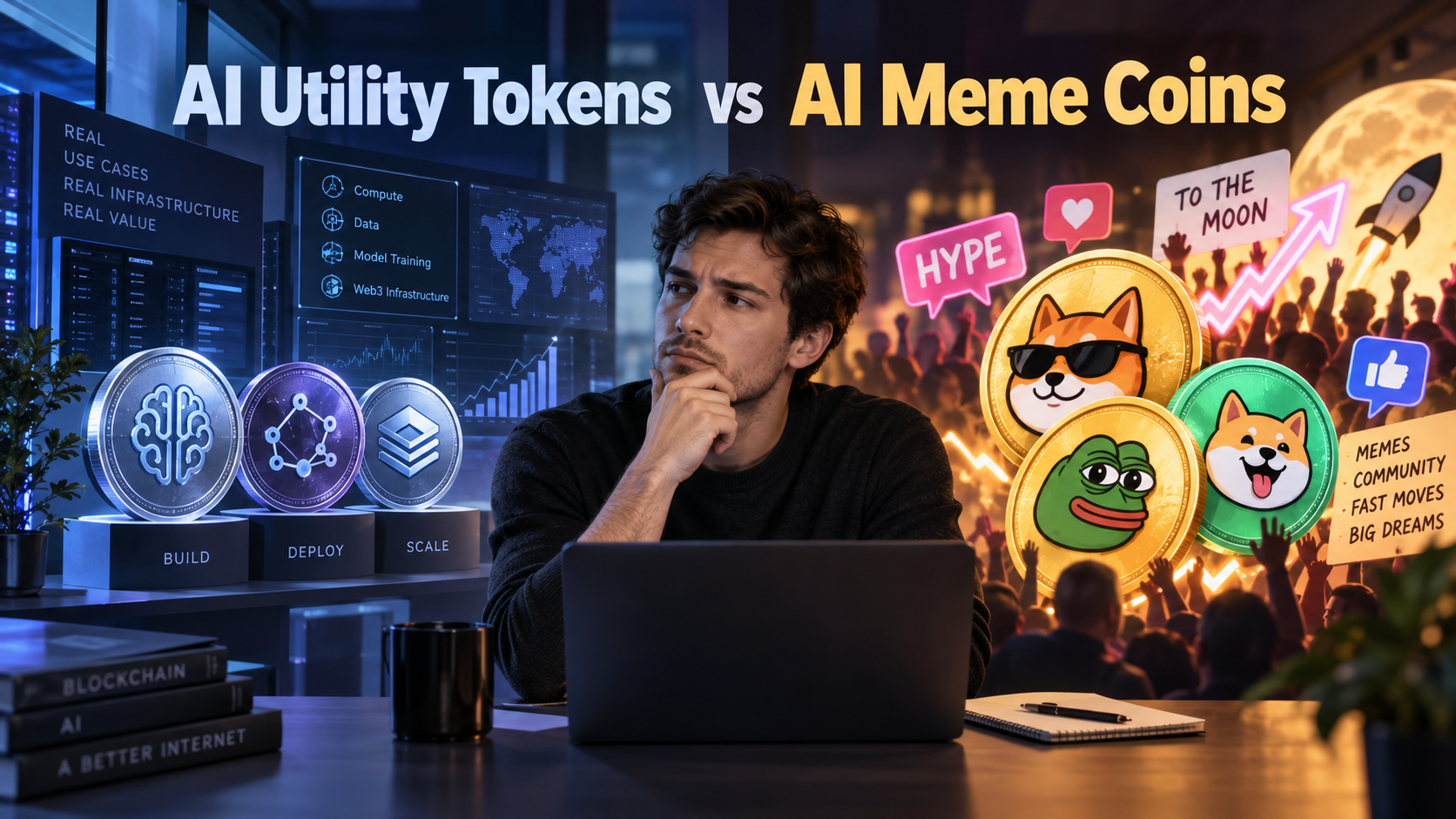
AI utility tokens are tied to a functional role such as network fees, AI services, compute, staking, or governance. FET, for example, is used for services, transactions, and staking in the Fetch.ai/ASI ecosystem, while TAO is the base token of Bittensor's decentralized AI network. AI meme coins draw their value mainly from community attention and AI-themed branding. Neither is inherently better. The real question is whether you want exposure to network adoption or accept attention-driven speculation.
Key Takeaways
- An "AI" label does not prove a token has meaningful AI-related utility.
- AI utility tokens can be analyzed through usage, demand mechanisms, and tokenomics, but real utility does not guarantee price appreciation.
- AI meme coins can build deep liquidity and loyal communities, yet they tend to depend heavily on narrative and market attention.
- Both categories can experience extreme volatility.
- Look at each token's actual role instead of treating all "AI crypto" as the same type of exposure.
What Is the Difference Between AI Utility Tokens and AI Meme Coins?
AI utility tokens
An AI utility token has an identifiable job inside an AI-related protocol or ecosystem: paying network or application fees, accessing AI services or compute, staking to secure a network, rewarding contributors of compute, models, inference, or data, or voting on governance.
FET illustrates the model, paying for transactions and AI services and supporting staking across the Fetch.ai/ASI ecosystem. Bittensor is structured differently. Under its Dynamic TAO model, each subnet functions as its own automated market maker, with one reserve holding TAO, the currency of the Bittensor network, and another holding a subnet-specific alpha token. Subnets compete to provide resources such as inference, compute, storage, and prediction.
AI meme coins
AI meme coins attract buyers primarily through memes, AI culture, online communities, personalities, or viral stories. Market data aggregators currently group projects such as TURBO, FARTCOIN, and GOAT among AI meme tokens, largely because of their origin stories or cultural links to AI rather than a protocol function.
These categories overlap, and aggregators do not use a standardized classification, so the same token can be labeled differently across data sites. A meme project can also add functionality over time, while a utility token can trade almost entirely on hype.
AI Utility Tokens vs. AI Meme Coins: Key Differences
|
Factor |
AI Utility Tokens |
AI Meme Coins |
|
Primary value proposition |
Use within a protocol or ecosystem |
Community, narrative, attention |
|
AI connection |
Usually tied to infrastructure, agents, compute, data, or models |
Often thematic or cultural |
|
What to research |
Adoption, usage, token utility, tokenomics |
Community, liquidity, holder concentration, narrative durability |
|
Fundamental metrics |
More commonly available |
Often limited |
|
Price drivers |
Adoption plus broader crypto speculation |
Sentiment, attention, and liquidity |
|
Main risks |
Weak adoption, unnecessary token, emissions, competition |
Narrative collapse, concentration, extreme volatility |
|
Due-diligence focus |
Product and token economics |
Market structure and community sustainability |
The table describes tendencies rather than guarantees. In practice, the category tells you where to start researching, not what conclusion you will reach.
Where Does Their Value Actually Come From?
Utility does not automatically create token value
For a utility token, the chain worth tracing is: product adoption → network activity → token demand mechanism → potential value capture. A break at any link weakens the thesis.
Useful questions: Does using the product require the token, or can users bypass it? Are fees paid or settled in the token? Does staking serve a genuine security or coordination function? Who receives fees and rewards? Are emissions growing faster than demand?
These answers should come from official documentation, not marketing. Bittensor's documentation, for instance, explains that each block, TAO is injected into a subnet's TAO reserve, alpha is injected into its alpha reserve, and further alpha is allocated for extraction by participants, with accumulated alpha distributed at the end of each tempo among the subnet owner, miners, and validators and their stakers. The same test applies to newer projects. JGGL, for example, operates a live AI-powered creative social network, and its official website describes $JGGL as the "fuel" for AI generations and for paying for ads inside the platform. Anyone following the JGGL price should distinguish that stated token utility from functionality that can be verified as live today, rather than assuming platform activity already translates into token demand. Verifiable mechanics like these separate a real protocol role from a decorative one.
AI Meme Coins Usually Depend More on Attention Than Conventional Fundamentals
AI meme coins usually follow a different chain: narrative → community attention → trading activity and liquidity → speculative demand. Viral distribution can often generate substantial demand with little or no conventional utility. The weakness is that attention tends to be mobile, and it can migrate quickly to the next AI narrative along with liquidity. Neither chain makes future price performance predictable.
Which Has More Risk: AI Utility Tokens or AI Meme Coins?
Risks specific to AI utility tokens
A working product may still attract few users, or it may succeed without creating meaningful demand for its token. High emissions or large unlocks can dilute holders, competitors may offer better technology without requiring a token, and some "AI" claims describe ordinary automation rather than meaningful AI infrastructure.
Risks specific to AI meme coins
Price depends heavily on social sentiment, and ownership may be concentrated among insiders or a few large wallets. Smaller tokens often have thin liquidity and large slippage, and narrative cycles can reverse abruptly. Copycat tokens with similar names or tickers can mislead buyers, and newer launches carry smart-contract, liquidity-removal, and rug-pull risks.
Risks shared by both
Both categories face broad crypto market volatility, smart-contract vulnerabilities, regulatory uncertainty, exchange and liquidity risk, and tokenomics that may favor insiders or early holders.
Which Type Fits Different Research Objectives?
This is a research framework, not a recommendation.
|
Objective |
Category More Relevant to Research |
Why |
|
Evaluate measurable network adoption |
AI utility tokens |
More protocol and activity metrics may exist |
|
Exposure to decentralized AI infrastructure |
AI utility tokens |
Token may link directly to compute, agents, models, or incentives |
|
Trade short-term narratives and social momentum |
AI meme coins |
Attention and sentiment drive markets |
|
Fundamental and tokenomics analysis |
AI utility tokens |
Usually more mechanisms to examine |
|
Accept highly speculative exposure |
AI meme coins |
Thesis depends less on traditional fundamentals |
A poorly designed utility token with heavy emissions and no real demand can have weaker fundamentals than a highly liquid meme coin with a durable community. Project-level analysis matters more than the label.
A 6-Point Checklist Before Buying Either Type
1. Identify what the token actually does
Separate concrete token functions from broad AI marketing.
2. Verify the AI connection
Check whether AI is central to the product or merely branding.
3. Examine token supply and unlocks
Compare circulating and maximum supply, review team and insider allocations, and check the unlock schedule and emission rate.
4. Check liquidity and holder concentration
Look at trading volume, order-book depth, large-wallet concentration, and whether liquidity is spread across reputable markets.
5. Look for evidence of adoption
For utility projects, track users, developers, network activity, and fees or resource consumption. For meme projects, gauge community activity, whether engagement is organic or incentivized, and whether attention persists beyond the initial hype.
6. Define what would invalidate the thesis
Set measurable exit conditions that match the category. A utility thesis might be invalidated by declining usage, stalled adoption, or evidence that users can bypass the token. A meme thesis might be invalidated by shrinking liquidity, rising holder concentration, or a sustained drop in community activity and attention.
Focus on the Token Thesis, Not the AI Label
The real choice is not simply utility versus meme. AI utility tokens offer a thesis that can potentially be tested against adoption, network activity, and token economics. AI meme coins rely more on attention, liquidity, community, and narrative durability. Before buying either, verify the token's actual role, supply structure, liquidity, concentration, and risks, and never treat the "AI" label itself as evidence of value.
FAQs
Does an AI token need real AI technology to have utility?
Not necessarily. What matters is whether the token has a necessary, verifiable role in an AI-related network or service, such as paying for compute or rewarding model providers.
What metrics show that people are actually using an AI token?
Focus on activity that requires the token: fees paid in it, compute or inference purchased with it, and wallets using the protocol rather than just trading. Revenue from paying customers is generally stronger evidence of organic product demand than activity driven primarily by token incentives.
Does staking automatically create demand for an AI utility token?
No. Staking supports demand only when it serves a real function, such as securing the network or rewarding productive participants. If yields come mostly from new emissions, staking may simply redistribute dilution.
How do emissions affect an AI token even when adoption is growing?
If new supply from rewards and unlocks grows faster than usage-driven demand, price pressure can persist while the product gains users. A wide gap between market cap and fully diluted valuation can signal substantial non-circulating supply and potential future dilution.
Why do crypto data sites classify the same AI token differently?
No standard taxonomy exists. Each aggregator uses its own methodology, sometimes including project-submitted tags. Treat these labels as a starting point, and confirm the token's function in official documentation.