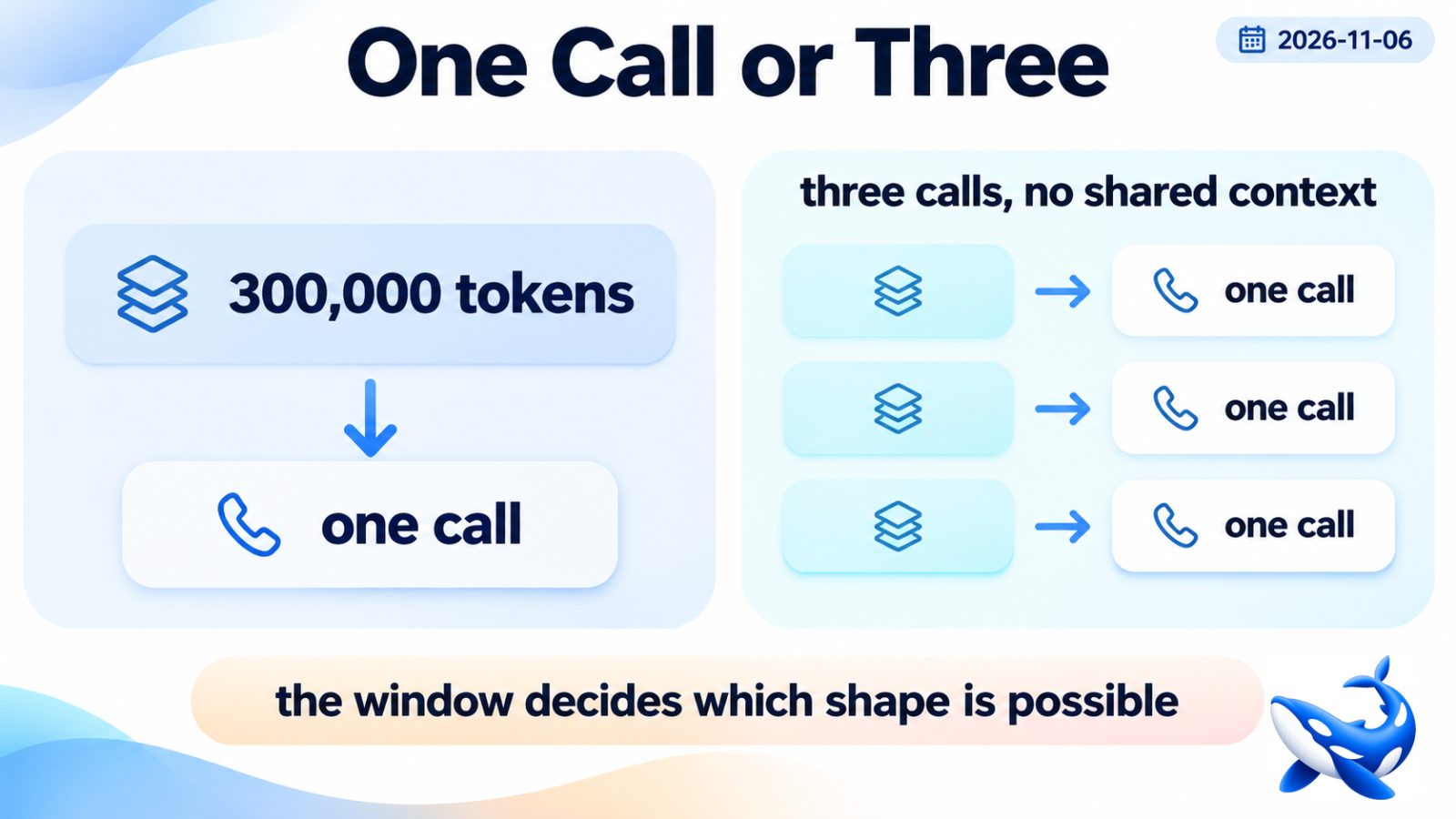
On OrcaRouter the window is the specification that decides which jobs fit. Most comparisons treat a context window as a capacity: bigger is better, and 1,000,000 tokens is bigger than 262,144. That framing is right up to the moment you have to use it, and then the window turns into a different question — whether the work can be done in one pass at all. OrcaCyber Zero 1.5 model offers 1,000,000 tokens of context and 128,000 tokens of output through OrcaRouter, at $3 in / $7.50 out / $0.75 cache.
Whether that window is worth paying for depends on a property of the task that no model card can tell you: does the answer require the whole artefact at once?
The three tasks that need one pass
Cross-file reasoning. A vulnerability that spans three files is not visible in any one of them. Chunk the repository and you get three confident partial answers and no finding.
Whole-artefact summarisation with a coherent structure. A report whose sections must agree with each other cannot be written by three models that never met.
Source-to-sink tracing. Following tainted input through a call graph means holding the graph; holding the graph means the window.
Everything else — classification of individual documents, extraction from a single file, triage of one log slice — chunks fine, and the cheap card at $0.15 does it without the window.
What the window costs when you use it
Take a 300,000-token repository audit with a 20,000-token report.
One call on this card: 300,000 × $3/M = $0.90 in, 20,000 × $7.50/M = $0.15 out, $1.05 total [OURS].
Three chunked calls on the cheap card: 3 × 100,000 × $0.15/M = $0.045 in, 3 × 7,000 × $0.60/M = $0.0126 out, $0.058 total.
The window costs 18 times as much. It also produces the only answer that answers the question — the cheap card's three summaries describe three files and miss the vulnerability that lived between them.
That is the trade, stated plainly: on this class of work the context window is not a premium feature, it is the difference between a correct result and a plausible wrong one.
The cache is what makes a long artefact affordable
If the audit is a one-shot, $1.05 is the whole cost. Investigative work is rarely one-shot: the analyst asks twenty follow-ups about the same repository.
At $0.75 per million cached tokens — 25% of input — re-sending 300,000 tokens costs $0.225 per follow-up instead of $0.90 [OURS]. Twenty follow-ups: $4.50 cached against $18.00 uncached. The cache does not make the card cheap; it removes the part of the bill that grows with the number of questions rather than the size of the artefact.
And it only works if the prefix is identical. A timestamp, a case id, a reordered tool list at the top of the prompt and every follow-up pays list. This card's 25% cache ratio is the least generous in the security line, so a broken prefix is proportionally more expensive here than on a card with a 2% ratio.
When not to use the window
Three signals that a task belongs on a cheaper card.
The artefact history does not change the answer. Classifying a document does not need the last ten documents.
Each question touches one file. If the analyst opens one file at a time, chunking matches the work.
The output must be short. A 128,000-token ceiling is generous for a report and irrelevant for a label.
Running those three checks before opening the window is worth more than any rate comparison, because they decide whether the expensive card is doing something the cheap one cannot.
What a million tokens does to the prompt you write
A window that large changes what belongs in a prompt. When the limit is 32,000 tokens, the work is deciding what to leave out. When it is a million, the work is deciding what to include — and that is a different skill with different failure modes.
Including too much dilutes the question. A model asked to find one flaw in 500,000 tokens of repository will read all of it and may anchor on whatever comes first. Precision in the question matters more than the size of the artefact.
Including too much costs money. 500,000 tokens at $3 is $1.50 per send [OURS]. Twenty sends is $30 for one investigation, most of it spent on files that had nothing to do with the answer. A retrieval step that picks 150,000 relevant tokens costs a fifth as much.
Including too much costs time. At 51.3 tokens per second and a 6,000-ms wait, a long context inflates the prefill before a single token appears.
The pattern that works is retrieval into the window, not the whole corpus into the window. The million is a safety margin for the retrieval being imperfect, not a licence to skip retrieval.
What the chunked alternative looks like in practice
The cheaper path is not "use a worse model". It is three passes with a merge step.
Pass one: split the artefact into 100,000-token windows and ask each for findings. At $0.15 per million that is $0.045 for 300,000 tokens [OURS].
Pass two: ask each window whether its findings depend on anything outside the window, and return the references. This is where cross-file issues surface, and it is a question a cheap card can answer.
Pass three: send the collected findings — a few thousand tokens — to a stronger card for synthesis.
The pipeline costs more engineering and roughly a twentieth of the tokens. On work where the answer is genuinely local, it produces the same result; on work where it is not, it produces a list of cross-references instead of a wrong answer.
That is the honest alternative to buying the window: more engineering, a twentieth of the tokens, and a result that is either the same or visibly different — never quietly wrong.
The takeaway
A 1,000,000-token window is worth its 18× price premium only on work that cannot be chunked: cross-file findings, coherent whole-artefact reports, source-to-sink traces. Use the cache to keep the follow-up questions cheap, check the three signals before opening the window, and remember that the cheapest card in the catalogue can answer the chunkable half of the same queue for a twentieth of the price.
Sourcing note: pricing, cache rate, context, output ceiling, latency, throughput, error rate and traffic figures are OrcaRouter production telemetry for the seven days ending 2026-11-05 [OURS]. Cost comparisons use the stated token counts and the published per-million rates for a security card and a cheap-tier card on the same gateway; the chunked example assumes three partial summaries of equal size. Access is restricted to authorized security research. Checked 2026-11-06.